The ITB email came in Tuesday morning. It sat there—third from the top—while he worked through the ones he already recognized. By Thursday afternoon someone finally asked about it in a meeting. The due date was next Wednesday. Nobody had opened the specs. No one had called the GC.
Now it’s movement.
Estimating gets pulled in late Thursday. They’re already juggling three other bids. Suppliers get calls Friday morning—“quick budget pricing,” “just need a number to carry.” No one has time to dig. No one really knows who else is bidding. There’s a set of drawings open on one screen, email threads stacking up on the other.
By Monday, it’s controlled chaos. Numbers are coming in incomplete. Scope gaps get filled with assumptions. Everyone knows it’s tight, but the job fits—right size, right type, right client. Too good to pass on.
The proposal goes out Wednesday.
And there’s a quiet moment after it’s sent where no one says it out loud, but everyone feels it: we got this out… but we didn’t really get into it.
This isn’t a one-off.
This is what happens when one person is effectively acting as a full-time filter for 50+ incoming emails a day—half of them ITBs, all of them competing for attention. Some get flagged. Some get skimmed. Some sit for a day or two because something more urgent came in behind them.
Not because anyone’s careless. Because the system depends on someone not missing anything in an environment designed to overwhelm them.
So opportunities don’t enter the company cleanly. They trickle in—late, uneven, and without context.
And when that happens, the entire pursuit phase compresses.
Construction likes to pretend the job starts when boots hit the ground.
It doesn’t.
It starts here—when the opportunity shows up and how quickly the right people can see it, understand it, and act on it.
When that window shrinks, everything downstream gets distorted.
Estimators don’t have time to vet numbers. PMs don’t have time to weigh in. Leadership doesn’t have visibility into what’s even being pursued. Decisions get made fast because they have to, not because they’re good.
And the project carries that weight from day one.
You don’t notice it immediately. It shows up later—unclear scope, thin margins, awkward conversations with subs, tension with the GC when something “wasn’t included.”
It feels like a project problem.
It’s not.
It’s an intake problem.
There’s an assumption baked into most teams: this is just the cost of doing business. Bids come in fast, you react fast, and the best teams are the ones who can scramble the hardest.
But that’s not actually the advantage.
The advantage is seeing clearly before you have to scramble.
Knowing what’s coming in, when it came in, who sent it, how often they send work your way—and making that visible to more than one person.
Because right now, that information lives in inboxes.
Private ones.
And that’s the real constraint.
Not the number of opportunities. Not even the speed.
It’s that the flow of information is fragmented and delayed, and the rest of the company is operating without it.
Business development is supposed to build relationships—but half the time, they don’t have a clean view of which GCs are actually sending them work. Estimating is supposed to evaluate opportunities—but they’re reacting to what gets forwarded, not what exists. Leadership is supposed to guide strategy—but they’re seeing a partial pipeline at best.
Everyone’s doing their job.
They’re just doing it with incomplete information.
When you fix that—when ITBs come in and are immediately structured, visible, and shared—the behavior changes.
Not dramatically. Quietly.
Estimators see opportunities earlier. PMs can weigh in before it’s urgent. Leadership starts to recognize patterns—who’s inviting, who’s not, what types of work are showing up consistently.
And business development?
They stop acting like email triage specialists.
They start acting like business developers again.
Because now they can actually see the landscape—who’s engaging with them, where the gaps are, where relationships need attention.
Everyone says construction is a relationship business.
That’s true.
But relationships don’t grow in the dark.
They grow when you can see what’s actually happening—and most teams can’t, at least not in time to do anything about it.
So what does that actually look like in practice?
It’s not another platform. It’s not asking your team to log into one more system.
It starts with the inbox.
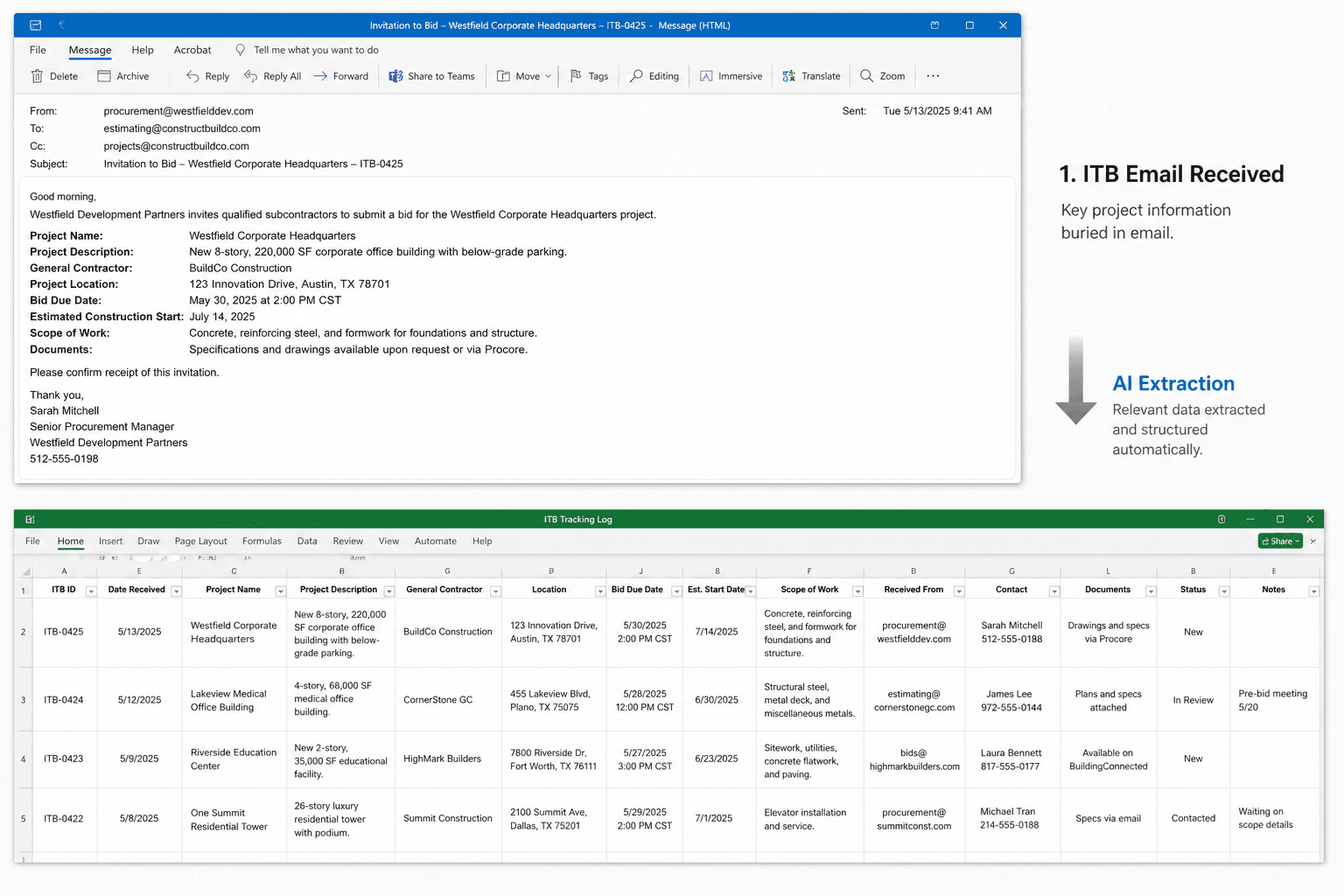
Every ITB that comes in—whether it’s from a GC you know or one you’ve never worked with—follows a pattern. Project name. Location. Bid date. Scope. Sometimes buried in the subject line, sometimes halfway down the email, sometimes attached in a PDF no one opens until it’s too late.
Right now, a person reads that. Decides if it matters. Maybe forwards it. Maybe doesn’t.
That’s the bottleneck.
Instead, that email gets parsed automatically. The key information—GC, project name, bid date, location, trade—is extracted the moment it hits the inbox. No one has to open it. No one has to decide if it’s worth sharing.
It just shows up—structured, consistent—in a live spreadsheet.
Now instead of 50 emails sitting in one person’s inbox, you’ve got a running list of every opportunity:
Sorted by bid date Filterable by GC Visible to estimating, PMs, leadership Time-stamped by when it actually came in
No interpretation. No delay.
Just signal.
And this is where it shifts from “nice to have” to operational leverage.
Because now the questions change.
Instead of: “Did we get anything from that GC recently?”
You can answer it in seconds.
Instead of: “Is this bid worth pursuing?”
You can see what else is due that week, what your team is already carrying, and make a decision with context.
Instead of: Forwarding emails and hoping the right people see them…
The right people are already looking at the same list.
The surprising part is how simple the mechanism is.
You’re not automating estimating. You’re not replacing judgment.
You’re just removing the friction between when information arrives and when the company can act on it.
And that gap—right now—is where most projects quietly fall apart before they even start.
That’s the shift.
Not AI as a flashy tool.
AI as a way to make sure the right people see the right opportunity early enough to actually do something about it.