The wrong question dominates AI conversations in construction offices: "How do we automate this process?"
The right question, and the one almost nobody asks first: "Why does this process exist in this shape?"
Every workflow your firm uses today was designed under constraints that are no longer universal. The estimator reviews legal terms after award because pre-award legal review used to be expensive and slow. The PE retypes vendor logs because translation between formats used to require human eyes. The PM writes the same status email every Friday because there was no faster way to surface the same data to the owner.
Those constraints are changing. AI doesn't just accelerate the old workflow. It often eliminates the reason the old workflow existed.
The Why–How Ladder is what gets you to that realization before you waste a quarter automating something that should have been deleted.
The Mechanic of It
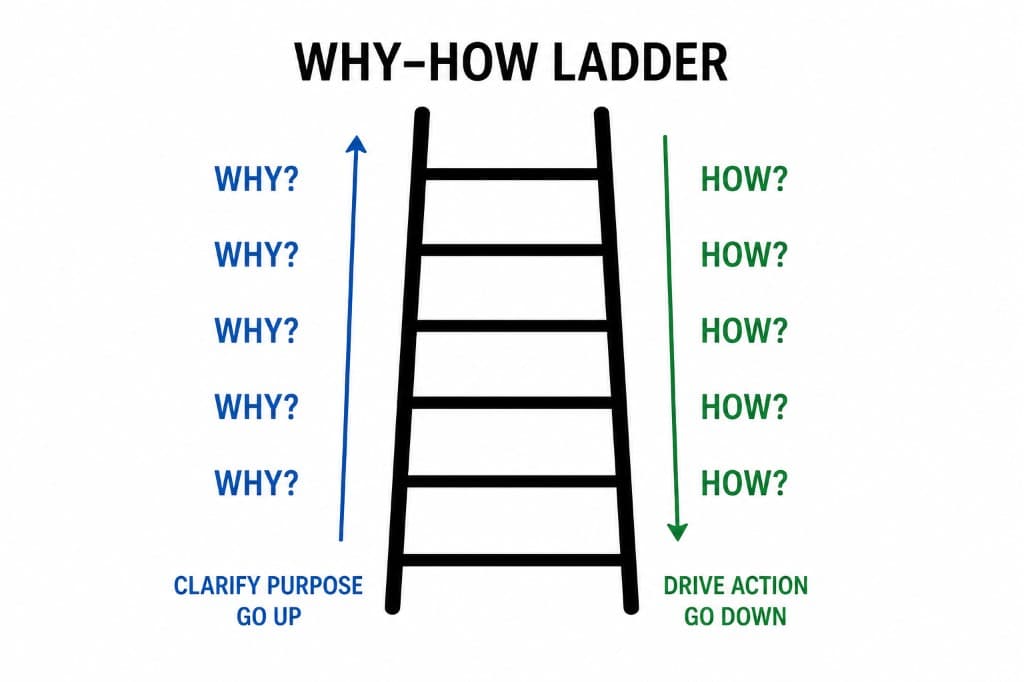
Two questions, traded back and forth.
Why? Why does this step exist? What are we actually trying to accomplish?
How? What's the best way to accomplish it now—given what AI can do?
Then again. Why does the new how matter? How does that change what we should do upstream of it?
You repeat until assumptions break or the workflow gets redesigned from the top down. Three to four rounds usually does it. More than that and you're overthinking.
A Ladder on a Real BD Workflow
Old assumption: legal review of an RFP happens after award.
Why? Because legal review was expensive and slow. The team only ran it once you had skin in the game.
How might AI change the cost of legal review? A model can run a first-pass risk scan in minutes against your standard baseline. Not a final legal opinion—a flag list.
Why would that matter? Because the cost of running a legal scan is now measured in compute, not in hours. So we can run it earlier. Specifically, before estimating starts. Specifically, before the bid/no-bid call.
How do we use that? The bid/no-bid memo now includes a contractual risk summary. The PX walks into the meeting already knowing whether this owner's contract has dealbreakers. The estimator doesn't waste two days pricing a job that's going to die in legal review post-award.
That's not "speeding up the old workflow." That's a different workflow entirely.
Another Ladder, This One Inside Buyout
Why does the PE manually format the leveling spreadsheet for every trade package?
Because the proposals come in twelve different shapes—Word, PDF, vendor-specific templates, scanned faxes from a sub who refuses to upgrade.
How might AI change that? A model can extract scope items, exclusions, qualifications, and prices from any PDF format and dump them into a standard schema in seconds.
Why does that matter? Because the PE's time used to be spent retyping. Now it can be spent comparing. The bottleneck moves from data entry to interpretation.
How does that change the broader workflow? The leveling meeting starts with a complete matrix. The PE shows up to discuss exclusions, not to apologize for not having everything in yet. The whole pace of buyout shifts.
The Trap You're Trying to Avoid
The trap is "automating the existing process." It looks like progress and it produces small wins. The PE saves twenty minutes a week. The PM gets a slightly better Friday.
But the company structure—the way work moves between departments, the way decisions get made, the way information flows from precon to ops—stays the same. You've made an old process slightly faster. You haven't made a better process.
The teams that pull ahead in the next three years are the ones who use AI to redesign the workflow, not just speed it up. The ones who get stuck are the ones who deploy AI on top of every existing process, save 10–15% per task, and never ask whether the task should exist at all.
Why the Ladder Is the Tool for Right Now
Three reasons.
It forces you to slow down at exactly the moment everyone else is rushing. The AI hype cycle wants you to grab tools. The ladder puts you back at the strategy level long enough to use the tools well.
It surfaces dead processes. Some of the workflow your firm runs today doesn't need to exist at all. The ladder is how you find that out without a consulting engagement.
It generates leverage. The teams that go through this exercise get repeatable wins because they're rebuilding workflows around what's possible now, not patching workflows built for a different decade.
How to Run It This Week
Pick one process that feels heavy. Daily reports. Bid intake. RFI logging. Submittal review. Buyout. Pursuit qualification. Doesn't matter which.
Run three rounds of Why → How → Why → How with the people who actually do the work, not the directors who watch them do it. Write down the answers.
At the end you should have one of three things: a list of steps that can be automated, a list of steps that should be deleted entirely, or a redesigned workflow that doesn't look much like the original.
Pilot it on one project. Not the whole company. Not a pursuit you can't afford to lose. Something contained.
If it works, scale. If it doesn't, run the ladder again with what you learned.
That's the entire methodology. There's no software to buy. The output is a process change that the team understands because they helped design it. That's the part that makes it stick.